The National Accounts results for the December 2025 quarter side with the RBA’s view that the consumer is in a strong position. Household income growth of 6.9% for the quarter (year on year) is well above trend. Consumer spending growth was 5.6% and discretionary spending outpaced staples spending. We view the December 2025 quarter as the peak in spending for the cycle. The combination of higher interest rates and higher petrol prices are likely to dent income growth and spending. However, the headlines about higher petrol prices may be worse than the actual outcome. A 15-35 cent lift in petrol prices would result in a 0.4% to 0.9% slowdown in retail sales growth on our estimates.
The national accounts for the September 2025 quarter provide an insight to the strength of the Australian consumer. The ABS has revised up historical income growth and in the September quarter household income rose 6.7%, with consumer spending up 5.7%. Income growth has averaged close to 8% so far in 2025. No wonder discretionary retail spending began growing above trend this year. The challenge is identifying sources that will result in any further acceleration in retail spending in 2026. We expect retail spending to continue to trend near current levels. The upside case relies on lower household savings which is possible if house prices rise double-digits, a low probability now given the lack of interest rate cuts any time soon.
Australia’s population growth tends to be higher than other developed countries, supported by higher net migration. In Issue 8 of The Retail Mosaic, we analyse the impact net migration has on retail spending, which categories tend to benefit most and which retailers are best located for migration growth. We find that migrants tend to spend more on food and fashion. Retailers that are best located include Super Retail Group’s Macpac and Rebel Sport. JB Hi-Fi and Bunnings also have store locations that provide a greater contribution from population growth.
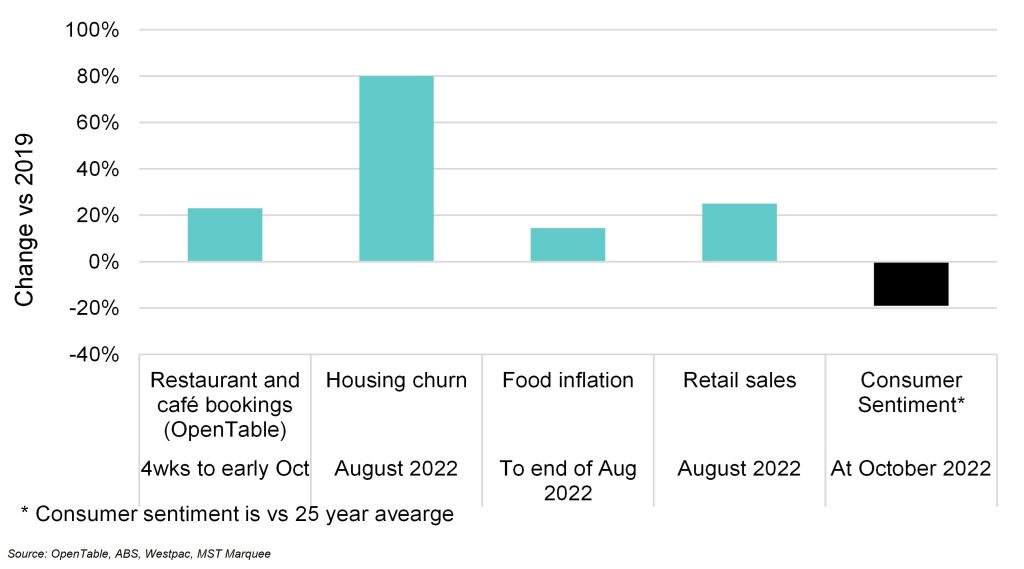
Consumer sentiment for October 2022 is 19% below the long-term average, suggesting consumers are worried. However, consumer sentiment is at odds with consumer spending. Most of the time what consumers say and what they do disconnect. Instead, we focus on measures of consumer behaviours in order to gauge the retail outlook. Restaurant and café spend has a 3x stronger correlation with retail spending than consumer sentiment. Restaurant bookings are up 23% on pre COVID-19 levels in October. Housing churn is up 80% on pre COVID-19 levels. Food inflation is 14% higher than 2019 and retail spending is up 25% on 2019 levels. There are no signs of a slowdown in spending behaviours on the near-term horizon.
The National Accounts for the June 2022 quarter paints a strong picture of the Australian consumer. Despite fears about higher interest rates, the prevailing climate is one where incomes are growing faster and savings are being drawn down gradually. We expect the strength of income and savings to outweigh the headwinds for at least another six months. It is fair to caution that once the slowdown arrives around mid-2023, it could be a protracted downturn.