
• Sort by

  • Industry

Toggle intro on/off

Measuring consumer behaviour vs consumer sentiment

The potential disconnect

12 October 2022
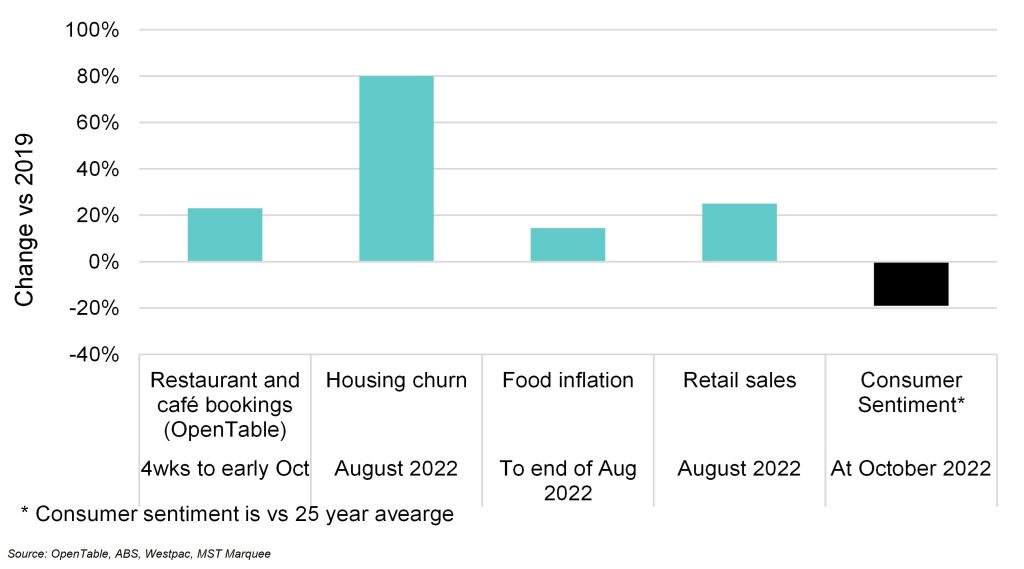
Consumer sentiment for October 2022 is 19% below the long-term average, suggesting consumers are worried. However, consumer sentiment is at odds with consumer spending. Most of the time what consumers say and what they do disconnect. Instead, we focus on measures of consumer behaviours in order to gauge the retail outlook. Restaurant and café spend has a 3x stronger correlation with retail spending than consumer sentiment. Restaurant bookings are up 23% on pre COVID-19 levels in October. Housing churn is up 80% on pre COVID-19 levels. Food inflation is 14% higher than 2019 and retail spending is up 25% on 2019 levels. There are no signs of a slowdown in spending behaviours on the near-term horizon.

Measures of consumer behaviour and sentiment

Retail sales for August 2022

Online sales decline

06 October 2022

Australian retail sales rose 19.4% year on year in August 2022. The three-year compound annual growth rate for August was 7.7%, very similar to July 2022 at 8.3%. The most interesting headline is online sales were down 15% year on year, but this largely reflects lockdowns from last year. The three-year online CAGR is still 27%. We expect overall retail sales will remain firm with the first signs of weakness likely in November 2022 given two years of high growth for that month. Retail sales are likely to be softer in 2023 as higher interest rates take effect and savings rates are lower.

What correlates with retail sales?

The disconnect between sentiment and spending

26 September 2022

In this report, we analyse  consumer sentiment and its role in predicting retail sales. Sentiment has a low correlation with retail spending other than during major crises. While it can help explain the consumer psyche, it doesn’t explain spending. Restaurant and café sales, housing churn, household deposits and food input cost inflation are all far more useful in predicting retail sales in the near-term. The Westpac-Melbourne Institute Consumer Sentiment survey was down 26% in September 2022 compared with long-term trends. Weak sentiment has been evident since March 2022 and contrasts strong retail sales growth.  These indicators are generally favourable with a broader slowdown in retail likely mid 2023. However, household goods categories could slow as soon as October 2022.

Australian national accounts for June 2021 quarter

Healthy income growth underpins retail spending

01 September 2021

Australian National Accounts for the June 2021 quarter show some normalisation compared with the lockdown impacts on income and spending a year ago. Two-year CAGR household income growth is 5% which compares with retail sales CAGR growth of 6% for the June quarter. Australians have also saved $243 billion since the start of 2020. This elevated level of savings will be the first bucket of money used for holidays when borders reopen. Any slowdown in retail spending is likely to be more modest than people expect.

Search result for "" — 628 articles found

Not already a member?
Join now to get all the latest reports in full and stay informed.

Get started