
Metcash will host an investor day on 17 and 18 October 2022. This is the first opportunity for new CEO Doug Jones to set his agenda for the company. We expect the focus to be about initiatives that drive sales, more so than margins. Updating the company’s IT and distribution centres is likely to be a near-term focus. We will look for information about initiatives to drive more store refurbishments as well. We are interested in longer-term challenges such as developing a better value offer and private labels; considering expansion into food service or pharmacy and how the business will compete online. The strategy may not move numbers much, other than higher capex in our view.
Domino’s share price has fallen a long way in 12 months. In just the past two months, the stock is down 29%. The main concern is European earnings. We agree and consensus may be 5%-10% too high for FY23e. Within the next six months, the company has enough flexibility to manage its costs and may start to see some cost recovery through pricing.
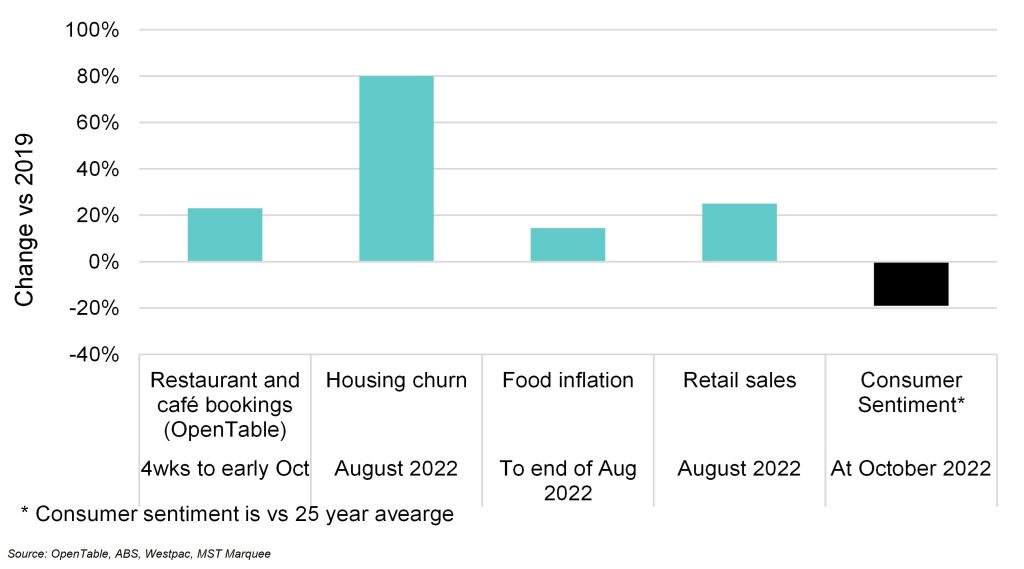
Consumer sentiment for October 2022 is 19% below the long-term average, suggesting consumers are worried. However, consumer sentiment is at odds with consumer spending. Most of the time what consumers say and what they do disconnect. Instead, we focus on measures of consumer behaviours in order to gauge the retail outlook. Restaurant and café spend has a 3x stronger correlation with retail spending than consumer sentiment. Restaurant bookings are up 23% on pre COVID-19 levels in October. Housing churn is up 80% on pre COVID-19 levels. Food inflation is 14% higher than 2019 and retail spending is up 25% on 2019 levels. There are no signs of a slowdown in spending behaviours on the near-term horizon.
Retail sales are a function of volume, price and mix. While volume and price receive plenty of attention, mix is often mis-understood, or not disclosed. In Issue 4 of Price Watch, we explore mix and its impact on sales. Successful businesses drive mix higher through their deliberate product and price decisions. Consumers will also make conscious choices about their basket mix depending on income, convenience, demographics and the cost of living. In the limited disclosure on mix we have, we find that it accounts for anywhere from one-quarter to half the sales growth for large retailers, with a higher contribution over the past two years. More disclosure on mix would lift perceptions about the quality of sales growth as pure price rises or excessive volume growth are often seen as unsustainable.
Endeavour’s Hotel segment is in greater focus given recent comments from various state governments about changing regulations on poker machines. We estimate gaming accounts for 24% of group EBIT for Endeavour. Given state governments generate over $6 billion in revenue from gaming machines, we see a shift of the profit pool to government in the form of higher taxes as the key risk to Endeavour. The perception of risk about poker machines will ebb and flow depending on news headlines.
Australian retail sales rose 19.4% year on year in August 2022. The three-year compound annual growth rate for August was 7.7%, very similar to July 2022 at 8.3%. The most interesting headline is online sales were down 15% year on year, but this largely reflects lockdowns from last year. The three-year online CAGR is still 27%. We expect overall retail sales will remain firm with the first signs of weakness likely in November 2022 given two years of high growth for that month. Retail sales are likely to be softer in 2023 as higher interest rates take effect and savings rates are lower.
While Premier Investments reported flat FY22 EBIT, it was a strong 2H22 with EBIT up 23%. The company had very strong second-half sales growth and gross margins expanded. We expect strong sales to persist in 1H23e, but then we are cautious about calendar 2023. Sales growth may turn negative in 2H23e and FY24e on our forecasts even with good growth plans for Peter Alexander. Moreover, wages and rents are likely to be a source of margin compression.
In this report, we analyse consumer sentiment and its role in predicting retail sales. Sentiment has a low correlation with retail spending other than during major crises. While it can help explain the consumer psyche, it doesn’t explain spending. Restaurant and café sales, housing churn, household deposits and food input cost inflation are all far more useful in predicting retail sales in the near-term. The Westpac-Melbourne Institute Consumer Sentiment survey was down 26% in September 2022 compared with long-term trends. Weak sentiment has been evident since March 2022 and contrasts strong retail sales growth. These indicators are generally favourable with a broader slowdown in retail likely mid 2023. However, household goods categories could slow as soon as October 2022.
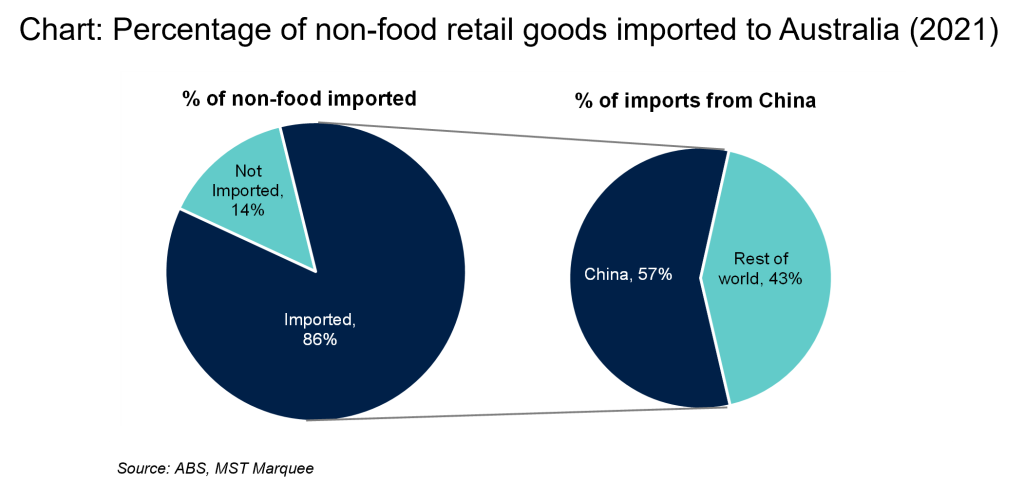
As global trade tensions build and geopolitical risks rise, we think Australian retailers are going to need to diversify their supply chains. Australia imports ~86% of its non-food consumer goods and we estimate 57% of these imports come from China. The productivity of China has led to a concentration of sourcing that represents a real risk on a 5-10 year horizon as Chinese wage rates rise further, supply chains face further disruptions and trade tensions rise. Electronics is the most at-risk category entirely imported, with 56% of imports from China, followed by clothing and accessories at 94% imported, with 55% from China.
Coles has announced the sale of its Fuel & Convenience business to Viva Energy. The company emphasises its desire to focus on its “omni-channel” supermarkets and liquor businesses, as well as become Australia’s most “sustainable” supermarket. The deal is mildly EPS accretive and a decent price for Coles. On our estimates the sale price is 12x EV/EBIT (FY23e) and 0.6% EPS accretive in FY24e. We do see some downside risks over time as Coles may lose the grocery wholesaling business and the cost of fuel discounts may rise.